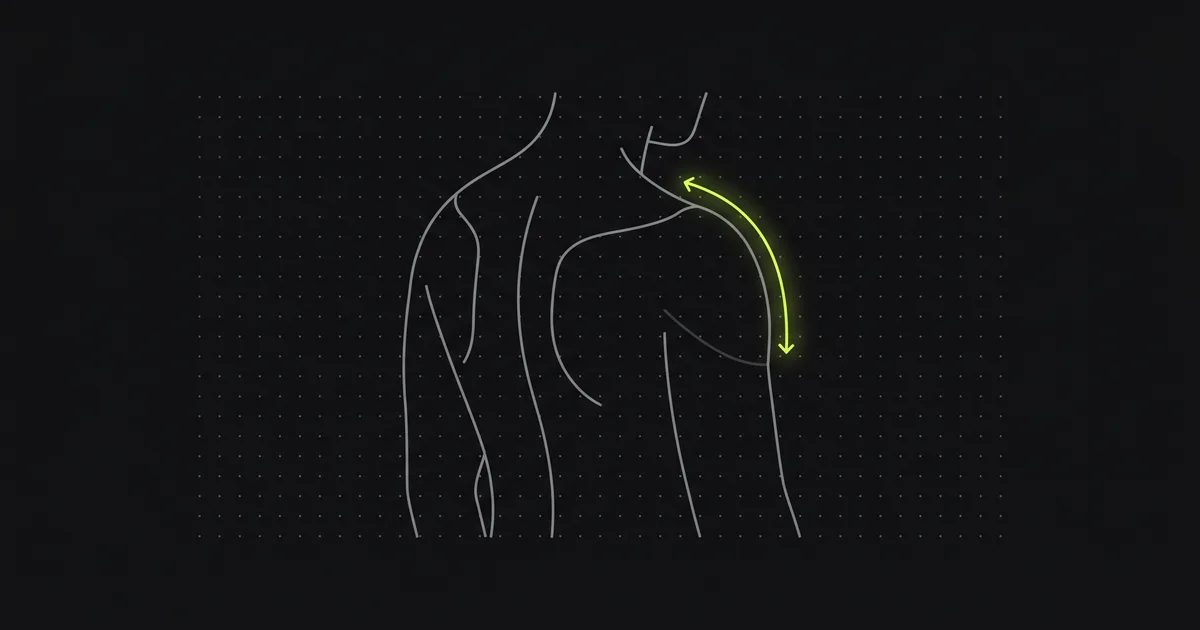
Rounded shoulders are the posture you fall into at a keyboard: shoulders rolled forward, chest a little collapsed, upper back curved. It usually travels with forward head posture, because once the shoulders come forward the head tends to follow. Like most screen-related posture patterns, it’s muscular and habitual, which means it responds well to a bit of targeted work.
You don’t need a brace to fix it. You need to loosen what’s tight at the front, strengthen what’s weak in the back, and stop feeding the pattern eight hours a day.
What rounded shoulders are
From the side, balanced shoulders sit roughly over your hips, with your arms hanging so the back of your hand faces behind you, not out to the side. With rounded shoulders, the whole shoulder girdle slides forward and rotates in. Look down and your palms face more toward the wall behind you; your thumbs point inward.
Underneath, it’s a tug-of-war that one side has been winning. The muscles across the front of your chest and the front of your shoulders get short and tight from hours in a forward position. The muscles between and below your shoulder blades, the ones that pull the shoulders back and down, get long and lazy. The shape is just the result of that imbalance held for years.
Why desk work rolls your shoulders forward
Everything about a typical desk setup pulls the shoulders in:
- reaching forward for a keyboard and mouse
- a mouse placed out to the side, which rolls one shoulder more than the other
- a screen that’s too low or too far, so you hunch toward it
- hours of stillness, so whatever position you start in is the position you keep
It’s not a strength problem in the usual sense. Your chest isn’t too strong; it’s just short and busy, while your mid-back has nothing asking it to work. Fix the imbalance and the shape changes.
How to check
Three quick ways, from fastest to most precise:
- The hand test. Stand relaxed and look at your hands. If your thumbs point at each other or your palms face backward, your shoulders are rolled in.
- The wall test. Stand with your back to a wall. See whether the backs of your shoulders touch it comfortably without you forcing them back.
- A side photo. Take a relaxed side-on photo and look at where your shoulder sits relative to your ear and hip. This is the one you can actually track over time.
Spine does the photo version automatically: its scan estimates shoulder roll along with forward head tilt and upper-back rounding, and turns the set into a single posture score. For a manual approach, see how to measure your posture at home.
The fix: open the front, strengthen the back
Loosen what’s tight
Give the short muscles at the front room to lengthen:
- Doorway pec stretch. Forearm on a door frame, elbow about shoulder height, step gently through until you feel a stretch across the chest. Hold, breathe, repeat on both sides.
- Open-book stretch. Lying on your side, knees bent, arms out front together, rotate the top arm open toward the floor behind you and follow it with your eyes. Slow and controlled.
Strengthen what’s weak
Wake up the mid-back so it can hold the shoulders back without you thinking about it:
- Scapular retractions. Draw your shoulder blades down and together, hold a couple of seconds, release. The cue is “down and back,” not “up by your ears.”
- Band pull-aparts. Hold a light resistance band in front of you and pull it apart, leading with the shoulder blades.
- Prone Y-T-W raises. Lying face down, lift your arms in a Y, then T, then W shape, squeezing the mid-back each time.
Reset your setup
The exercises won’t win against eight hours of the opposite. Pull the keyboard and mouse close so your elbows stay near your sides, raise the screen to near eye level, and use the backrest. Our desk posture guide covers the full setup.
Do you need a posture corrector?
A brace can be a useful reminder for a week or two while you build the habit, but it doesn’t make the mid-back stronger, so it doesn’t fix the cause on its own. We go into the trade-offs in do posture correctors work?. The short version: train the muscles, fix the setup, and use a brace at most as a temporary cue.
How long it takes
You can feel taller and looser within a week, mostly from the stretching and from breaking up long still stretches. Changing the resting position enough to show up in a photo usually takes a month or more of consistent work, because you’re rebuilding strength and a habit at the same time.
This is where a measured baseline earns its keep. Re-check your shoulder roll the same way every week or so and watch the trend. Spine packages the stretch-and-strengthen work into a 7-minute daily program weighted toward whatever your scan flags, so if your shoulders are the worst of it, that’s where the minutes go. Either way, measuring is what turns slow, easy-to-miss progress into something you can actually see.