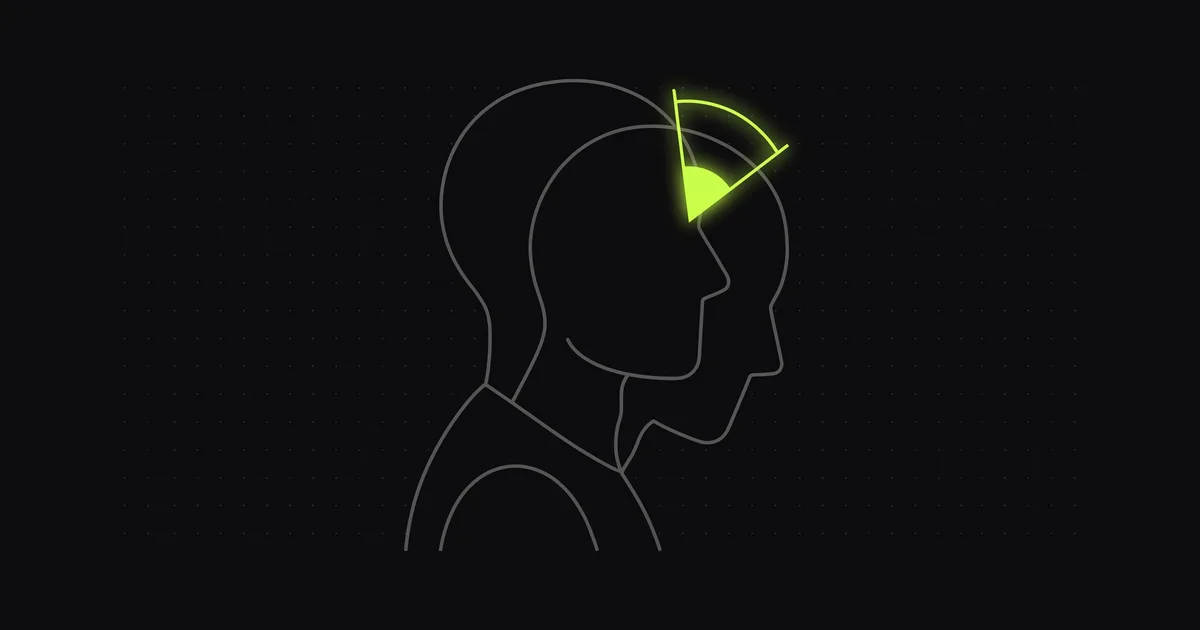
Forward head posture is the technical name for what most people call “tech neck” or “nerd neck”: the head sitting in front of the shoulders instead of stacked over them. It’s one of the most common postural patterns in people who work at a screen, and one of the most responsive to a bit of focused effort.
This guide covers what it is, the angles that actually define it, and a routine you can run in a few minutes a day to change them.
What forward head posture is
In a balanced standing position, your ear, shoulder, and hip line up roughly vertically. The head’s weight passes straight down through the spine, and the muscles around your neck do very little.
Forward head posture shifts that stack. The head moves forward of the shoulder line, often with a rounding of the upper back and shoulders that roll inward to match. The deep muscles at the front of the neck weaken, the muscles at the back and base of the skull tighten, and the position becomes the new normal, because it’s the position you hold for most of the day.
It develops quietly. Nobody decides to crane forward; it accumulates from thousands of hours of looking at screens slightly too low and slightly too far away.
The angles that define it
Forward head posture isn’t a vague feeling. It’s geometry you can read from a side-on photo.
- Craniovertebral angle (CVA). Draw a line from the C7 vertebra (the bony bump at the base of your neck) to the tragus of your ear (the small flap in front of the ear canal), then measure the angle it makes with horizontal. A more upright head gives a larger angle. Research commonly treats a CVA under about 50° as forward head posture, though thresholds vary between studies.
- Thoracic rounding. How much the upper back curves forward. More rounding usually drags the head further forward to keep your eyes level.
- Shoulder roll. How far the shoulders sit forward of the spine, which tends to track with the other two.
These three are what Spine estimates from a single side photo, combining them into one posture score from 0 to 100. The score isn’t a diagnosis; it’s a consistent baseline you can re-check, so “I think I’m standing taller” becomes “the angle moved four degrees.” For a deeper look at the mechanics, see tech neck, explained.
What causes it
The usual suspects are all about position held over time:
- screens below eye level, so you look down for hours
- phones read at lap or chest height
- a chair that lets the pelvis roll back, which rounds the whole spine above it
- long stretches of deep focus where you stop moving entirely
The common thread is duration. Any one position is fine for a while. The pattern forms because the position barely changes for the whole working day.
Can you actually fix it?
Yes, with a realistic timeframe. Forward head posture is mostly muscular and habitual, not structural, especially in people under their forties without an underlying condition. That means it responds to two things: changing the position you spend the most time in, and rebuilding strength in the muscles that hold your head back.
What you can’t do is fix it in a day, or with a single stretch. You’re retraining a default the body has held for years, so the work is small, specific, and repeated. That also happens to be the kind of change that sticks.
The fix: setup, then a daily routine
Reset the position
Before any exercise, fix the inputs. This is where most of the change comes from, because it changes the most hours:
- Raise your monitor so the top is near eye level, about an arm’s length away.
- Bring your phone up toward your eyes instead of dropping your head down to it.
- Set your chair so your hips are level with or slightly above your knees and your pelvis isn’t rolling back.
Our guide on desk posture for developers goes through the full setup.
Strengthen what holds your head back
These wake up the deep neck flexors and the muscles between your shoulder blades, the team that keeps your head stacked:
- Chin tucks. Sitting tall, gently draw your head straight back to make a “double chin” without tipping it down. Hold a few seconds, repeat. This is the single most useful move for the position.
- Wall angels. Stand with your back against a wall and slide your arms up and down keeping contact. Trains the upper back to extend instead of round.
- Scapular squeezes. Draw the shoulder blades down and together, hold, release.
Mobilize what’s tight
- Upper-trap and levator stretches to ease the muscles that have been overworking.
- Thoracic extension over a chair back or foam roller to undo the upper-back rounding that pulls the head forward.
A simple 7-minute structure
You don’t need a long session. A short, ordered routine does more, daily, than an hour once a week: a few minutes of decompression and mobility to loosen what’s tight, then a few minutes of strengthening to hold the new position.
That’s the structure Spine’s daily program uses: short guided sessions with timed holds, weighted toward the angles your scan flags. If your forward head tilt is the worst of the three, more of the time goes there.
How to know it’s working
Two signals, in this order:
- Less tension, within a week or two. Usually the first thing you notice once the muscles get regular relief and a reason to share the load.
- A measurable change in the angle, over a month or more. This is the one that confirms real change rather than a good day. Re-scan or re-photograph from the same spot, same distance, same time of day, and compare the number.
Measuring matters here precisely because the change is slow and easy to lose faith in. A baseline you re-check weekly turns invisible progress into a line you can watch climb, and watching the number go up is what keeps the routine going long enough to work. If you’d rather start by measuring, read how to measure your posture at home.