Posture correctors are everywhere: elastic straps and braces that pull your shoulders back and promise to undo a slouch. They’re cheap and the pitch is appealing, so the question is fair: do they actually work?
The honest answer is “a little, and only at one thing.” A corrector is a decent reminder. It is not a fix. Here’s the difference, and what to do instead.
What a posture corrector actually does
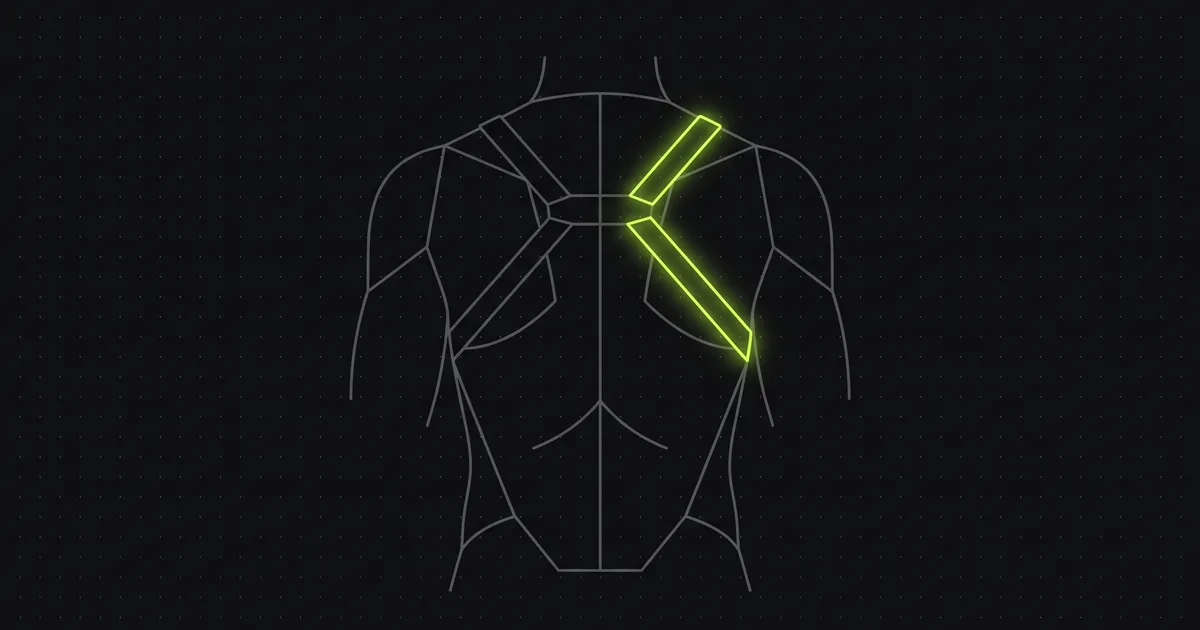
Most correctors work by physically pulling your shoulders back, usually with straps over the shoulders and across the upper back. When you start to slouch, the brace tightens or tugs, and you feel it. That cue prompts you to sit up.
That’s the whole mechanism: a tactile reminder. It’s not holding your spine in a “correct” position so much as nudging you to correct yourself. Which is genuinely useful for one specific problem, and useless for another.
Where a brace helps
The honest case for a corrector is short and real:
- Awareness. Most slouching is unconscious. A brace makes you notice the moment you collapse, which is the hardest part to catch on your own.
- A short-term cue while you build a habit. Worn for short stretches over a week or two, it can help you learn what neutral feels like so you can find it without the strap.
If that’s what you want it for, fine. Used that way, it’s a training wheel.
Where braces fall short
The problems start when a corrector is sold as the solution:
- It doesn’t build strength. Rounded shoulders and forward head posture come largely from a weak, under-used mid-back and a tight front. A brace holds you in position; it doesn’t ask any muscle to get stronger. Take it off and nothing has changed underneath.
- Your muscles can switch off. If the strap does the holding, the muscles that should hold you up have less reason to work while you’re wearing it. That’s the opposite of training them.
- Comfort kills consistency. Braces are easy to stop wearing because they’re uncomfortable for long stretches, so the reminder you were relying on quietly disappears.
None of this makes them a scam. It makes them a reminder being sold as a cure.
What the evidence says
Be skeptical of strong claims in either direction. The research on posture braces is limited and mixed: some small studies find short-term improvements in awareness and perceived posture while a device is worn, but there’s little good evidence that wearing one produces lasting structural change once it comes off. The pattern fits the mechanism. A cue helps while it’s cueing; it doesn’t rebuild capacity.
(Worth saying plainly: this is general information, not medical advice. If you have pain or a diagnosed condition, a brace might be recommended for you specifically, and that’s a conversation for a clinician.)
A better default: measure, then train
If the cause is a weak back and a tight front held all day, the fix is to change those things directly:
- Measure a baseline. You can’t tell if anything is working without one. A side photo or an app scan gives you the angles to track. See how to measure your posture at home.
- Fix the setup. Most of your day is spent at a desk, so that’s where most of the change comes from. Raise the screen, pull the keyboard close, use the backrest.
- Strengthen and mobilize. A few focused minutes a day on the mid-back and the tight front does what a brace can’t. Our guide on rounded shoulders covers the specific moves.
- Re-measure. Check the trend every week or so. Watching the number move is what keeps the habit alive long enough to matter.
This is the approach Spine is built around: scan to get a posture score from real angles, then run a 7-minute daily program tuned to what your scan flags. The reminder isn’t a strap pulling on your shoulders; it’s a number you can watch climb. And the scan runs on-device, so your photo never leaves your phone.
Bottom line
Do posture correctors work? As a short-term awareness tool, sort of. As a fix, no. They hold you in place without building the strength or the habit that keeps you there. If you want a posture that holds up when you’re not thinking about it, skip the dependency and train the thing directly: measure where you are, fix your setup, strengthen your back, and track the change.