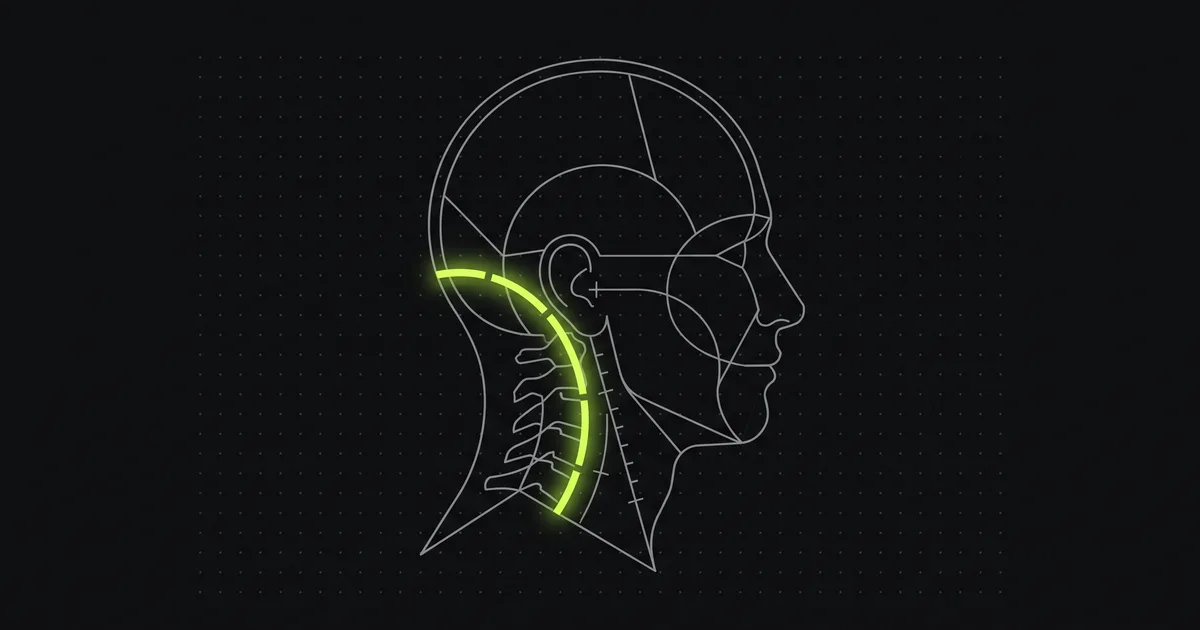
“Tech neck” is the everyday name for forward head posture caused by screens: the slow drift of the head out in front of the shoulders that builds up over years of looking down at a phone and across at a monitor. It isn’t a diagnosis, and it isn’t permanent. It’s a postural pattern you can see in a side photo, put a number on, and change.
If your neck feels tight by mid-afternoon, or your upper back aches after a long session, this is the mechanism worth understanding first.
What tech neck actually is
Your head weighs about 5 kg (11 lb). When it sits balanced over your spine, ears stacked over shoulders, your neck muscles barely work to hold it up. The skeleton does the job.
Tech neck is what happens when the head stops sitting over the spine. Looking down at a phone or leaning toward a monitor moves it forward. The further it drifts, the harder your neck and upper-back muscles have to pull just to stop it falling further. Hold that position for eight hours a day and those muscles stay switched on the whole time.
The “tech” part is just the cause. Screens give us a reason to hold the same head-forward position for hours, every day, for years, and the neck adapts to the position it’s kept in most.
Why screens cause it: the load math
The reason forward head posture matters is leverage. The further your head sits in front of your shoulders, the longer the lever your neck has to counterbalance, so the effective load climbs fast.
A useful rule of thumb from biomechanics research: for every 2–3 cm the head drifts forward of neutral, the load your neck muscles carry roughly doubles. A head held a few centimetres forward can put the equivalent of 12–18 kg of strain through the neck instead of 5. Your muscles don’t fail at that load. They just work harder, all day, and let you know about it later.
Two things make screens especially good at this:
- Phones pull your gaze down. Reading at chest or lap height tips the head forward and down, the most demanding angle for the neck.
- Monitors pull your gaze forward. A screen that’s too low, too far, or set too far back nudges the head out to meet it, and you hold it there while you focus.
Neither is dangerous in a single sitting. The cost is cumulative. It comes from the hours, not the moment.
What it feels like
Tech neck rarely announces itself. It shows up as the background symptoms most screen workers have learned to ignore:
- tightness at the base of the skull or across the top of the shoulders
- a dull ache between the shoulder blades that’s worse late in the day
- stiffness when you turn your head to check a blind spot
- tension headaches that ease on weekends
None of these proves damage. Usually they’re signs that a set of muscles has been working overtime in a shortened position. That’s reassuring, because muscles respond quickly when you change the position you keep them in.
How tech neck is measured
You don’t have to guess whether your head has drifted forward. It’s measurable from a single side-on photo.
The most common measure is the craniovertebral angle (CVA): the angle between a horizontal line and a line drawn from the bony bump at the base of your neck (the C7 vertebra) up to the small bump in front of your ear canal (the tragus). A more upright head gives a wider angle; a head that’s drifted forward gives a narrower one. Researchers often treat a CVA below about 50° as a marker of forward head posture, though the exact threshold varies between studies.
This is what Spine reads. Its scan estimates the angles that describe your posture (forward head tilt, thoracic rounding, shoulder roll) from one side photo, and turns them into a single posture score from 0 to 100. The point isn’t a clinical diagnosis. It’s a consistent number you can re-check week to week to see whether the position is actually changing. If you’d rather measure by hand first, see how to measure your posture at home.
How to undo tech neck
The fix has two halves: change the position your neck spends the most time in, and give the muscles on the back of your neck and upper back a reason to get stronger. Neither needs a clinic.
At your desk
Small changes to your setup do most of the work, because they change thousands of hours:
- Raise the screen. The top of your monitor should sit around eye level so your gaze drops only slightly. A stack of books works as well as a stand.
- Bring it closer. Position the screen about an arm’s length away so you don’t lean in to read.
- Lift the phone. Bring it up toward eye level instead of dropping your head to it.
- Move before you stiffen. A short position change every 30–45 minutes does more than one long stretch at the end of the day.
A daily reset
Setup fixes the input; a short routine rebuilds the capacity. A few minutes a day of targeted movement (gentle neck decompression, opening the upper back, waking up the muscles between the shoulder blades that hold the head back) retrains the position over weeks. This is the idea behind Spine’s 7-minute daily program: short, guided sessions aimed at the specific angles your scan flags, so the work goes where it’s needed instead of being generic.
For the strengthening side specifically, our guide on the forward head posture fix walks through the angles and the movements that change them.
How long it takes to change
Honestly: weeks, not days. You can feel less tension within the first week of changing your setup, because the muscles get periodic relief. Visible change in the angle, the kind a re-scan picks up, usually takes consistent effort over a month or more, since you’re retraining a position the body has treated as default for years.
That’s the case for measuring it. A number you re-check weekly turns slow, invisible progress into something you can watch climb, which is the difference between a habit that sticks and one that fizzles out by Wednesday.
Tech neck is a position your body learned. With a better setup and a few focused minutes a day, it’s a position your body can unlearn.