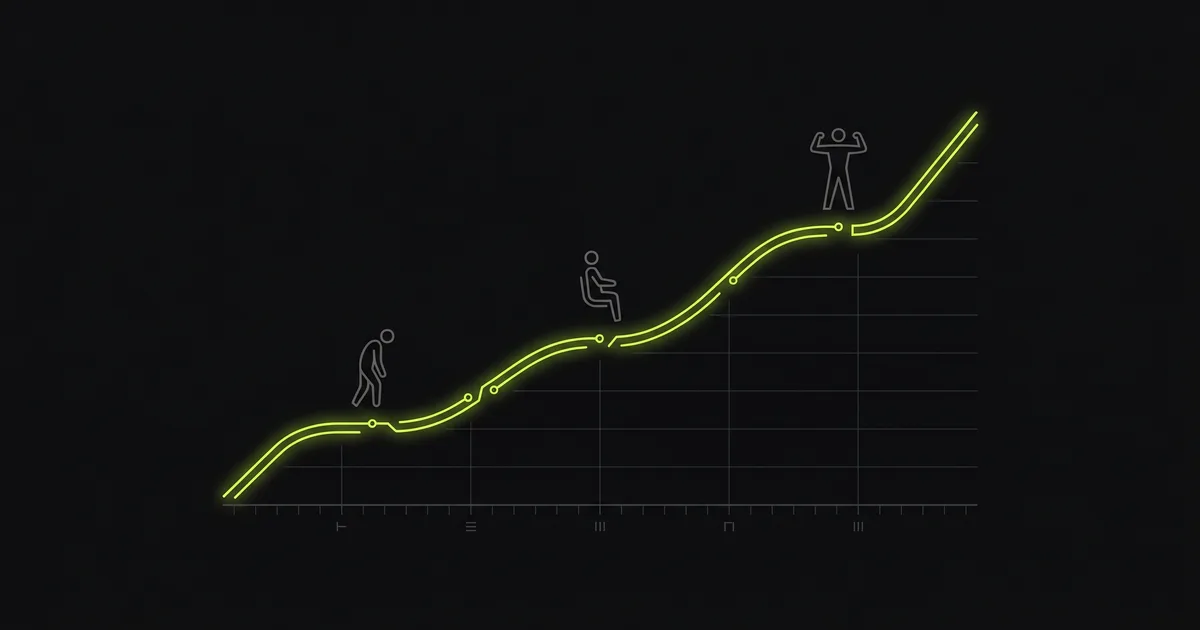
Short version: you’ll feel a difference in days, you’ll see one in weeks, and it becomes your default in a few months. The exact pace depends on how far things have drifted, how consistent you are, and whether you fix your desk setup or just do exercises around it.
The more useful answer is to break it down by timescale, because each stage looks and feels different, and knowing what to expect is half of not quitting.
Days 1–7: relief, not transformation
In the first week, the change you notice is comfort, not shape. Once you start breaking up long still stretches and doing a bit of targeted movement, the muscles that have been working overtime get periodic relief. Tension at the base of the neck and across the shoulders eases. That’s real and worth having, but it’s not your posture changing yet. It’s your muscles getting a break.
This is also the stage where setup changes pay off fastest. Raising your monitor or pulling your keyboard closer changes thousands of hours going forward, and you feel the reduced strain almost immediately.
Weeks 2–6: the position starts to change
This is where actual change begins. Give it consistent effort and the muscles that hold you upright, the mid-back and the deep neck flexors, start to get stronger, while the tight muscles at the front lengthen. Your resting position shifts a little. You catch yourself sitting taller without deciding to.
By around the four-to-six-week mark, the change is usually big enough to show up in a measurement: a few degrees on your forward head angle, a visibly different shoulder line in a side photo. It’s gradual, which is exactly why measuring matters here. Day to day you can’t feel a four-degree change, so without a number it’s easy to assume nothing is happening and stop.
Months 2–3 and beyond: the new default
Past a couple of months of consistency, the upright position stops being something you do and becomes something you are. The strength is there to hold it without conscious effort, and the habit is built into your day. You still need to maintain it, because the desk job that caused the drift hasn’t gone anywhere, but maintenance is far lighter than the initial work.
This timeline assumes a typical screen-worker pattern with no underlying medical issue. Structural changes, older bodies, or specific conditions can move slower, and that’s a question for a clinician, not an article.
What makes it faster
- Fix the setup first. It changes the most hours, so it does the most work. See desk posture for developers.
- Short and daily beats long and occasional. A few focused minutes every day retrains a position better than one long weekend session.
- Target the right thing. If your real issue is rounded shoulders, neck work won’t move the needle. Measure first so your effort goes where it counts.
What makes it slower
- Doing exercises but keeping a bad setup. You’re fighting your desk for eight hours and undoing it for seven minutes. The desk wins.
- Inconsistency. Posture is a habit being rebuilt; gaps reset the momentum.
- No measurement. Without a baseline, slow progress feels like no progress, and “no progress” is the most common reason people quit at week three.
Why measuring keeps you honest
The single biggest predictor of whether you’ll stick with this isn’t the routine. It’s whether you can see it working. Posture changes too slowly to feel, so a number you re-check weekly is what turns invisible progress into a line you can watch move.
That’s the whole idea behind Spine: scan your posture to get a score from real angles, then run a 7-minute daily program tuned to your results, and re-scan to watch the number climb. (The scan runs on-device, so your photo never leaves your phone.) If you’d rather measure by hand, start with how to measure your posture at home. Either way: get a baseline, give it weeks not days, and let the trend keep you going.